
Equal opportunities do not settle the timing question
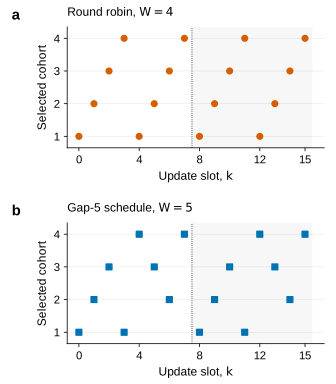
Four fixed groups choose between two identical options using information that is one update old. A round-robin schedule looks fair: each group updates once every four slots. Yet, in this model, its regularity reinforces delayed overreaction. The balanced eight-slot sequence 1,2,3,1,4,3,2,4 changes the ordering without changing anyone’s long-run frequency.
The exact result is confined to response strengths 3.75–4.25. Across that whole interval, round robin is unstable and the displayed schedule is locally exponentially stable. A separate combinatorial lower bound rules out a smaller stabilizing maximum gap: every schedule with a gap bound of four must repeat a permutation of the groups. Thus the minimal feasible gap is five, not merely the smallest gap found in a numerical search.
What the experiments add
All 2,520 balanced period-8 schedules were evaluated. The period-12 search screened 369,600 balanced candidates and evaluated the 1,488 with maximum gap at most five. The best evaluated gap-5 period-12 schedule contracts faster per slot than the period-8 construction, showing that the smallest fairness relaxation and the fastest convergence are different objectives.
Deterministic initial-state and phase checks and 320 finite-agent runs test specific extensions, not a global theorem. The comparison preserves inconvenient results: independent random updating has smaller fluctuation in the tested populations but cannot promise a fixed maximum update gap; changing the information delay can remove the stabilizing behaviour.
Read When Taking Turns Makes a System Unstable for the model, exact argument, eight research figures, paired comparisons and limits. This is a personal research study using synthetic data. It is not a student contribution record, an empirical service trial or a claim of a new published theorem.
Key findings
- For four equal fixed cohorts and delay one, the smallest stabilizing maximum gap is five throughout beta in [3.75,4.25]. Round robin is unstable and the displayed gap-5 schedule is locally exponentially stable.
- At beta=4, the best evaluated gap-5 per-slot radii are 0.97159 at period 8 and 0.90180 at period 12; these are finite-search results, not an unrestricted optimum.
- IID updates have lower synthetic fluctuation in the tested cases but no deterministic hard update-gap bound. Delay two retains nonzero tail fluctuation for both fixed schedules.
Limitations
- The theorem concerns local stability in a specified homogeneous model, not global attraction, actual waiting times or human behaviour.
- Twenty exposed development seeds per policy and population are not a held-out confirmatory sample.
- Novelty, a journal submission and student authorship are not claimed. The public article is a personal mathematical research explanation.
Technical record
Detailed source, calculations, generated figures, and reproduction instructions are maintained in a private technical workspace. Public articles contain only manually reviewed interpretation and approved figures.
Version history
2026-09-10 — Curated overview reviewed against repository evidence.