
Editorial overview
The literature gate returned REFRAME because multi-element polynomial chaos, discontinuity detection, stochastic bifurcation analysis, and uncertain CSTRs already have direct precedents. The defensible local contribution is a transparent single-case stress test, not a new generic method.
Read When Polynomial Chaos Crosses a Fold for the analytic fold derivation, explicit cold-start history, matched 16-call fit design, exact reliability metrics, retained environment and visual-QA failures, reproduction record, and locked next stages.
Key findings
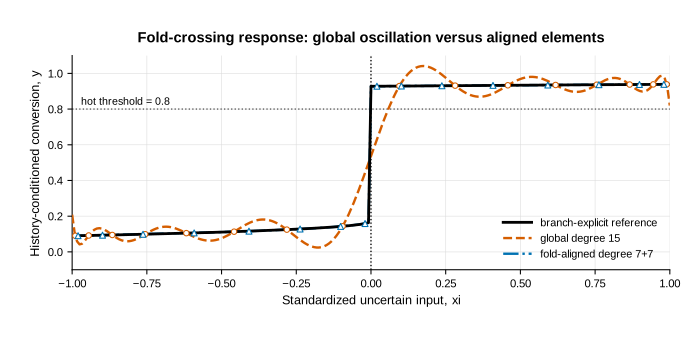
- At 16 fit forward evaluations per method, response RMSE was 0.0783280594 globally and 0.000248551855 with the oracle fold-aligned degree-7+7 construction.
- Wasserstein-1 error was 0.0439521168 globally and 5.03489790e-5 fold-aligned, corresponding to improvement factors of about 315.14 and 872.95 for RMSE and Wasserstein-1.
- Under the declared history, analytic hot probability was 0.5; the global surrogate gave 0.4710647474 and 0.0531311035 invalid-support mass, while the fold-aligned surrogate gave 0.5 and zero measured invalid-support mass.
Limitations
- This is a Phase-1 synthetic benchmark using an analytic fold as an oracle boundary; fold discovery and setup cost are excluded, so it is neither adaptive nor a total-cost comparison.
- It covers one dimensionless CSTR, one symmetric fold-centered input law, one branch history, one polynomial allocation, and one 16-evaluation fit budget.
- It establishes no finite-rate dynamics, physical calibration, industrial or chemical safety conclusion, automatic partitioning, final sweep, or universal superiority.
Technical record
Detailed source, calculations, generated figures, and reproduction instructions are maintained in a private technical workspace. Public articles contain only manually reviewed interpretation and approved figures.
Version history
2026-08-29 — Curated overview reviewed against repository evidence.