
Editorial overview
The literature gate returned REFRAME: periodic homogenization, effective-diffusivity release models, microstructure-resolved transport, connectivity effects, and finite-transient deviations are established. The local contribution is an auditable finite-scale replication-extension benchmark, not a new effective coefficient or a general pharmaceutical model.
Read When Effective Diffusivity Stops Being Effective for the model derivation, frozen 24-case protocol, exact reliability map, early-fit holdout witnesses, failed-attempt history, numerical and visual audits, reproduction commands, and locked next stages.
Key findings
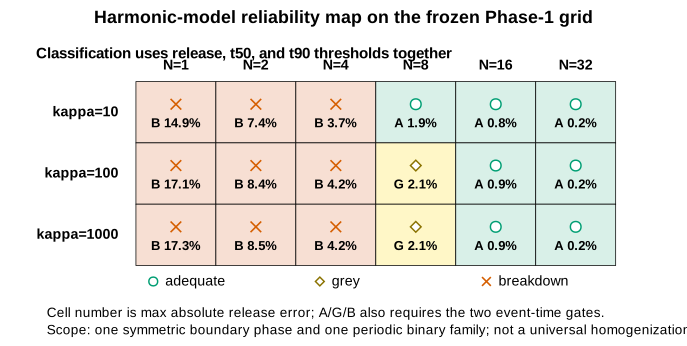
- Among 18 heterogeneous cases, the harmonic model was adequate in seven, grey in two, and in breakdown in nine under predeclared trajectory, t50, and t90 gates.
- Every tested contrast was in breakdown at N=1, 2, and 4; at N=8 contrast 10 was adequate while contrasts 100 and 1000 were grey; all tested contrasts were adequate at N=16 and 32.
- Exactly three N=1 cases passed the early-window fit-error gate yet missed held-out t90 by 11.11% to 12.17%; later release was excluded from fitting.
Limitations
- This is a synthetic diffusion-only Phase-1 benchmark for one one-dimensional periodic binary geometry, one slow boundary phase, fixed perfect sinks, and a 24-case grid.
- It omits swelling, erosion, degradation, dissolution, binding, reaction, moving interfaces, finite external mass transfer, random or imaged morphology, and physical calibration.
- Its release fractions and t50/t90 are synthetic curve events; it supports no clinical, dose, efficacy, safety, general homogenization, or universal cell-count claim.
Technical record
Detailed source, calculations, generated figures, and reproduction instructions are maintained in a private technical workspace. Public articles contain only manually reviewed interpretation and approved figures.
Version history
2026-08-29 — Curated overview reviewed against repository evidence.