
Editorial overview
Read Topology at the Edge of Resolution for the complete mathematical model, literature review, frozen experiment, observation-error audit, failure analysis, limitations, and ten approved figures.
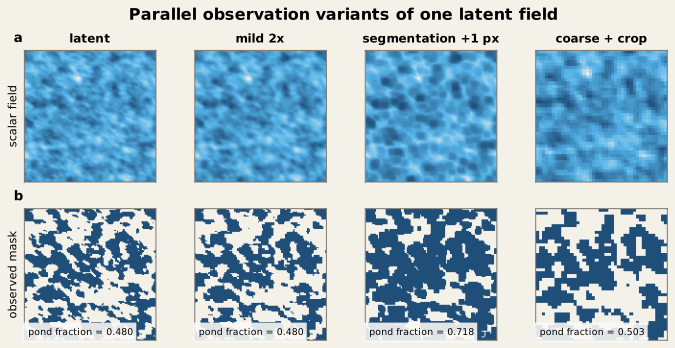
The study holds each latent pond field fixed while blur, pixel size, a paired one-pixel segmentation-boundary displacement, boundary texture error, and crop change its observed representation. Direct spanning, a discovery-calibrated pond-fraction constant, a fractal-gradient breakpoint, Euler and Betti curves, exact persistence-pruned Betti curves, and a pond-interior distance bottleneck throat are compared against the same high-resolution oracle.
Use the Melt-Pond Topology Lab to explore how nearly unchanged pond area can coexist with a reversed connectivity decision. The public article and lab expose no private source, notebook, raw geospatial file, or coordinate-level image.
Key findings
- No diagnostic passed every generator-by-observation robustness gate, so the benchmark abstains from naming a universally resolution-robust threshold signal.
- Raw spanning had the lowest pooled median absolute error at 0.0144 [95% bootstrap interval 0.0124–0.0163], but its p90 was 0.0666 and the worst Matérn segmentation-displacement stratum reached median 0.08555 and p90 0.12913.
- The bounded MOSAiC case reports aggregate topology on one 71,875-cell common domain; it is not latent truth, and Sentinel-2 was excluded after HTTP 503 requests because its metadata did not declare the floe-motion/co-registration transform needed for controlled pixelwise comparison.
Limitations
- The synthetic Matérn, germ–grain, and random-field Ising families are controlled morphology tests, not calibrated Arctic climate or drainage models.
- The latent truth is a finite-window, four-connected pond spanning threshold; other hydraulic, radiative, or ecological definitions can produce different thresholds.
- The two-date MOSAiC case tests representation sensitivity and cannot identify latent percolation truth, seasonal timing, or a causal melt mechanism.
Technical record
Detailed source, calculations, generated figures, and reproduction instructions are maintained in a private technical workspace. Public articles contain only manually reviewed interpretation and approved figures.
Version history
2026-08-24 — Curated overview reviewed against repository evidence.