
Editorial overview
The literature gate returned REFRAME because Michaelis-Menten singular perturbations, IMEX/AP error analysis, uniformly accurate conditions and positive conservative kinetics integrators are established. Kaiser and Schutz (2018) directly overlaps the proposed method headline.
Read One Integrator Across the Fast-Slow Boundary for the model, update equations, algebraic property audit, tightened Radau reference, frozen error grid, preserved backward-Euler comparison null, RK4 failures, reduced-model boundary and reproduction record.
Key findings
- The closed-form linearly implicit update analytically preserves the exact weighted invariant, remains nonnegative with c at most one, and has the correct fixed-step epsilon-to-zero update.
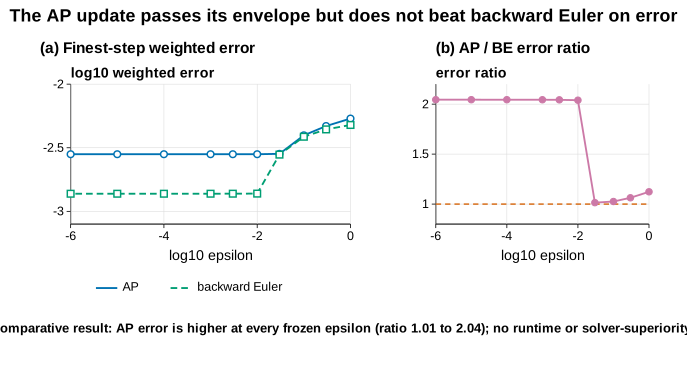
- The minimum last-pair order is 0.7885, the maximum fixed-step AP-limit discrepancy is 3.4480e-7, and the finest-step uniform weighted-error envelope is 0.0053654 on the frozen grid.
- The comparative hypothesis is null: AP error exceeds backward-Euler error at every frozen epsilon by factors from 1.0143 to 2.0444; RK4 fails or becomes nonphysical in 28/40 fixed cases.
Limitations
- The evidence covers one synthetic dimensionless irreversible Michaelis-Menten family, ten epsilon values, four fixed steps and one ill-prepared initial condition.
- The project introduces no new AP/IMEX solver or uniform-accuracy theorem and contains no external Radau/BDF/VODE work-precision comparison.
- There is no biochemical parameter fit, experiment, biological validation, clinical claim or runtime-superiority result.
Technical record
Detailed source, calculations, generated figures, and reproduction instructions are maintained in a private technical workspace. Public articles contain only manually reviewed interpretation and approved figures.
Version history
2026-08-30 — Curated overview reviewed against repository evidence.