Editorial overview
The literature gate returned REFRAME: efficient rare-event sampling for genetic switches is already established, so a generic “enhanced sampling beats direct simulation” claim would not be new. The defensible project is a reliability-boundary benchmark, but only its smallest Phase-1 foundation has been executed so far.
Read How Rare Is a Flip? for the declared exclusive-toggle CTMC, the fixed first-hit event, the finite-state probability bracket, the seeded SSA comparison, the retained failed truncation, and the exact limits on interpretation.
Key findings
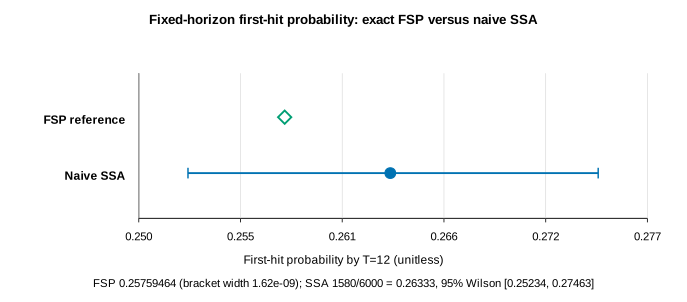
- At cap 20, the FSP bracket was 0.2575946379–0.2575946395 with overflow probability 1.62e-9.
- Seeded naive SSA recorded 1580 hits in 6000 trajectories, or 0.26333, with a 95% Wilson interval of 0.25234–0.27463.
- Thirty of 32 independently seeded batch intervals intersected the FSP bracket; this is a smoke diagnostic, not a definitive coverage study.
Limitations
- This is only the synthetic low-copy Phase-1 smoke regime, not the final preregistered rarity ladder.
- The retained cap-18 failure and the passing cap-20 truncation audit validate reference handling, not a biological model.
- AMS and FFPilot were not implemented or evaluated, so the study makes no rare-event speedup or method-ranking claim.
Technical record
Detailed source, calculations, generated figures, and reproduction instructions are maintained in a private technical workspace. Public articles contain only manually reviewed interpretation and approved figures.
Version history
2026-08-29 — Curated overview reviewed against repository evidence.