
Editorial overview
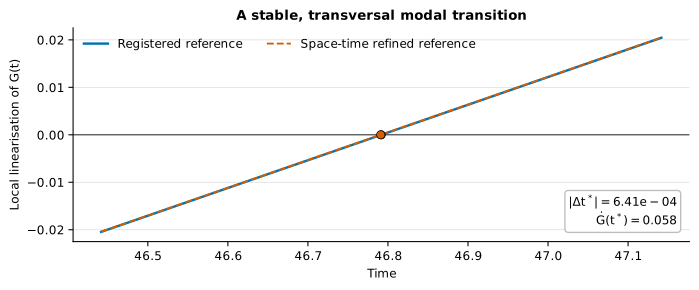
The experiment now reaches the adaptive comparison. A verified independent reference gives a smooth mode-6 to mode-7 crossing, then uniform, residual, and DWR meshes receive identical production degrees of freedom. Uniform is least inaccurate, while every method misses the registered error ceiling.
Read Can a Mesh Preserve the Event? for the model, event sensitivity, matched-work design, four publication figures, the coarse-pilot diagnosis, and the refinement ladder needed before any broader claim.
Key findings
- The independent reference event is 46.7916; refinement moves it by 0.000641 and the crossing slope is 0.0584.
- At equal 36-element production work, uniform has event-time error 2.6001, DWR 3.2752, and residual adaptation 4.4030.
- All errors exceed the registered 1.5 ceiling, so the retained Phase-1 verdict is REFRAME rather than a method-superiority claim.
Limitations
- This is one deterministic 36-element smoke experiment, not a convergence study or a general ranking of adaptive methods.
- The one-shot DWR mesh inherits a late coarse-pilot event and its residual mixes spatial, temporal, and splitting effects.
- The synthetic one-dimensional model has no biological calibration, and estimator overhead is excluded from matched primal work.
Technical record
Detailed source, calculations, generated figures, and reproduction instructions are maintained in a private technical workspace. Public articles contain only manually reviewed interpretation and approved figures.
Version history
2026-09-05 — Curated overview reviewed against repository evidence.