
Editorial overview
The literature gate returned REFRAME. Deterministic global bounds, interval branch-and-bound, convex relaxations, Latin-hypercube designs, scenario methods and CSTR uncertainty analysis are established. The local contribution is a compact, inspectable certificate-versus-incumbent benchmark.
Read Random Stress Tests Are Not Certificates for the reduction proof, valid upper enclosure, frozen sampling designs, exact 0/32 result boundary, local-search failure modes, reproducibility signature, figure audit and full literature record.
Key findings
- Monotonicity reduces the three-variable bounded maximum exactly to the corner z=-20 and H=0.5, leaving a certified one-dimensional temperature problem.
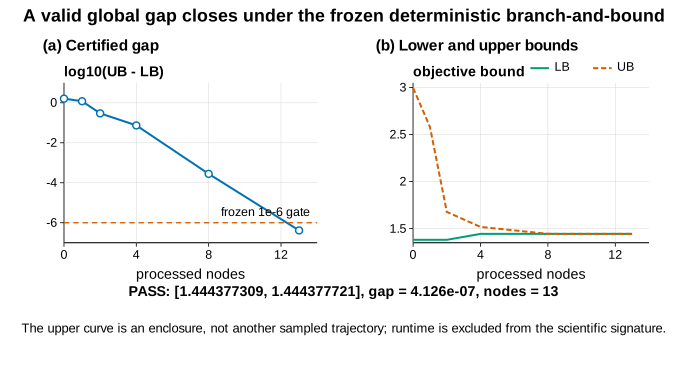
- The final interval is [1.4443773087849885, 1.4443777214279065], narrower than the frozen 1e-6 tolerance after 13 processed nodes.
- Each fixed IID and Latin-hypercube budget recorded 0/32 hits, but that count has no population miss-probability meaning; local search supplies incumbents and never a global upper bound.
Limitations
- The objective is a synthetic dimensionless algebraic thermal-drift proxy, not a dynamic, physical, experimental or plant CSTR model.
- The zero-hit record applies only to the declared seeds, budgets and 1e-4 rule; no probability or confidence claim is made.
- The certificate covers only the analytically reduced one-temperature interval at the proved corner and introduces no new global-optimization algorithm.
Technical record
Detailed source, calculations, generated figures, and reproduction instructions are maintained in a private technical workspace. Public articles contain only manually reviewed interpretation and approved figures.
Version history
2026-08-30 — Curated overview reviewed against repository evidence.