
Editorial overview
Read When One Reactor Has Three Temperatures for the model derivation, stability geometry, verified hysteresis experiment, basin interpretation, critical-slowing diagnostic, and five approved figures.
The calculations and executable research materials remain in the private ScienceProject workspace. This page presents only the reviewed public interpretation and approved visual evidence.
Key findings
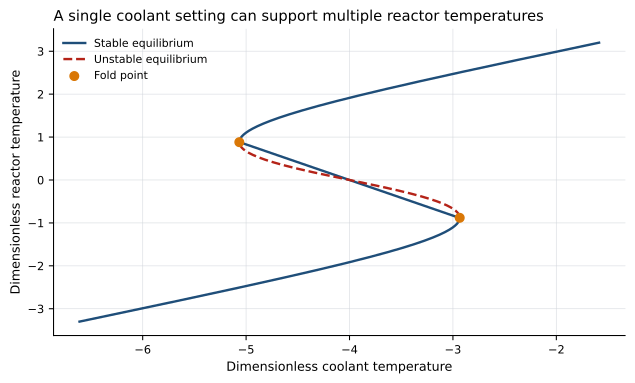
- The configured equilibrium branch folds at coolant values -5.06568 and -2.93432, creating a three-equilibrium interval.
- Warming and cooling follow different stable branches; recovery time increases as the ignition fold is approached.
Limitations
- The model is dimensionless and synthetic rather than an industrial reactor calibration.
- Transport delay, mixing imperfection, multiple reactions, actuator limits, and parameter uncertainty are omitted.
Technical record
Detailed source, calculations, generated figures, and reproduction instructions are maintained in a private technical workspace. Public articles contain only manually reviewed interpretation and approved figures.
Version history
2026-07-30 — Curated overview reviewed against repository evidence.