
Editorial overview
Read When Randomness Defeats Natural Selection for the four biological clocks, theory-as-test comparisons, migration balance, bottleneck memory, four approved figures, and a careful separation of process, Monte Carlo, and model uncertainty.
Key findings
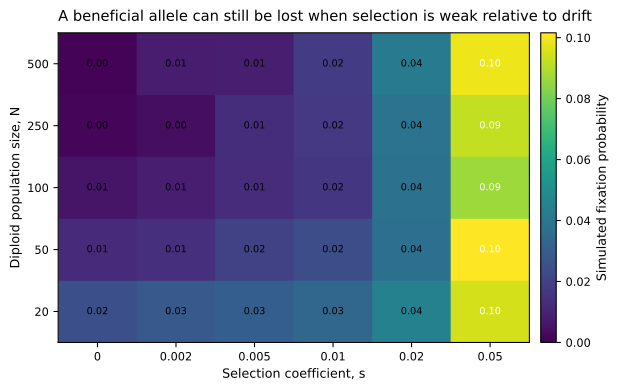
- A selection coefficient of 0.05 raised fixation to about 0.09–0.10, so most new beneficial copies still disappeared.
- A ten-generation bottleneck from 500 to 10 left final heterozygosity near 0.252, versus about 0.417 without the bottleneck.
Limitations
- These are idealized Wright–Fisher experiments, not estimates for a named population.
- Linked selection, mutation during fixation runs, and genomic ascertainment are outside scope.
Technical record
Detailed source, calculations, generated figures, and reproduction instructions are maintained in a private technical workspace. Public articles contain only manually reviewed interpretation and approved figures.
Version history
2026-07-30 — Curated overview reviewed against repository evidence.