
Editorial overview
The literature gate returned COMPLETE / REFRAME because common diagonal, copositive, quadratic, switched, robust and scalable positive-system certificates are established. The local contribution is an auditable two-state evidence-hierarchy benchmark, not new control theory or a new solver.
Read From Simulation to Certificate for the Metzler family, stress construction, Lyapunov derivation, distinction between finite diagnostics and all-parameter endpoint certificates, exact 6/6 gate audit, development-selection boundary, rejected-to-revised figure history, reproduction hashes and locked next stages.
Key findings
- At zero stress, diagonal and full constructed decay bounds agree to a relative 3.596327e-11 in the manufactured midpoint check.
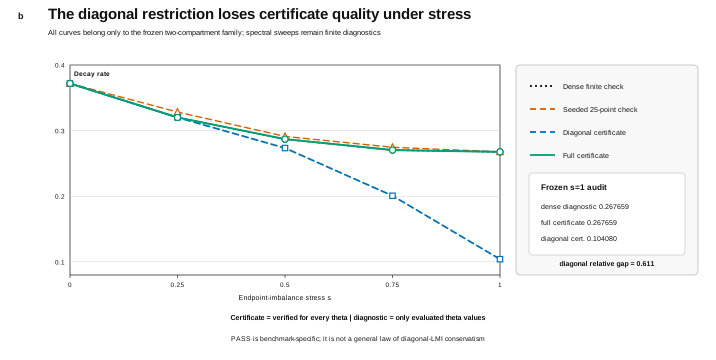
- At full stress, the dense finite diagnostic is 0.2676586726, the verified full certificate is 0.2676585204, and the verified diagonal certificate is 0.1040795885, giving a benchmark-specific diagonal gap of 0.6111480807.
- The maximum full-to-dense gap is 5.686579e-7 and the largest 241-versus-121 construction-grid change is 6.763624e-5; neither statistic establishes global SDP optimality.
Limitations
- The evidence covers one deliberately selected synthetic two-state affine segment and does not establish a general law of diagonal-LMI conservatism.
- Dense and seeded spectral sweeps remain finite diagnostics, while the deterministic grid constructs feasible trace-normalized matrices without proving a globally optimal SDP solution.
- No large-network scaling, physical system, experimental data, controller, safety conclusion, new theorem, or universal certificate ranking is provided.
Technical record
Detailed source, calculations, generated figures, and reproduction instructions are maintained in a private technical workspace. Public articles contain only manually reviewed interpretation and approved figures.
Version history
2026-08-30 — Curated overview reviewed against repository evidence.