
A correspondence is not a witnessed history
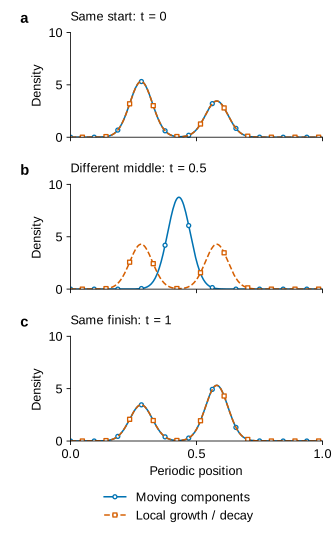
Two maps may show a hotspot changing location without revealing whether material moved or local density changed. This study supplies known histories to a controlled benchmark, then lets the estimator see only their endpoints.
Four scenario families cover translation, uniform growth, mixed movement and local growth, and swapped two-peak weights. Three geometries, 256-cell periodic fields and fixed penalty and entropy settings make the comparison explicit. A normalized balanced baseline shows what is lost when total mass is removed before fitting.
What is established
The sharpest example is structural: the same endpoint pair comes from a moving history and a stationary reaction history. No endpoint-only estimator can distinguish those histories without additional assumptions or observations.
Numerical checks support the implemented objective and the selected main-grid precision. They do not convert a minimum-cost correspondence into a causal explanation. The study retains negative controls, parameter sensitivity and nonconverged baseline entries instead of using endpoint fit alone as evidence of mechanism recovery.
Read Did the Hotspot Move, or Did It Grow? for the bilingual long-form explanation, eight data-driven figures and the next testable question: what extra observation would exclude the competing history?
Key findings
- All 4,320 main entropic UOT fits converge, but convergence does not identify the physical history.
- Static allocation and generating dynamic action are distinct quantities; their agreement is tested rather than assumed.
- Equal-mass endpoint pairs admit both moving and stationary-reaction histories, imposing a worst-history fraction error of at least one half for any endpoint-only diagnostic.
- Identical maps can produce positive regularized transport cost, including a 99.29% static share in the illustrated no-change control.
- Fourteen of 540 normalized balanced fits reach the fixed iteration cap and are not treated as converged baseline solutions.
Limitations
- The static quadratic-cost KL formulation is not exactly the dynamic Wasserstein–Fisher–Rao metric.
- Deterministic parameter grids are not independent samples; category cutoffs and cost prices are conventions.
- This is an established-method synthetic interpretation study, not a new solver, novelty claim or ecological validation.
Technical record
Detailed source, calculations, generated figures, and reproduction instructions are maintained in a private technical workspace. Public articles contain only manually reviewed interpretation and approved figures.
Version history
2026-09-19 — Curated overview reviewed against repository evidence.