
Editorial overview
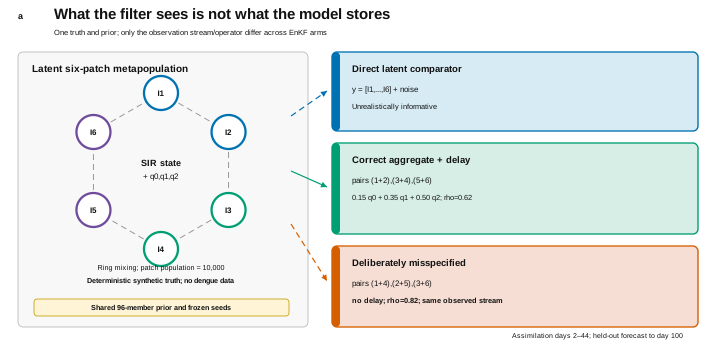
The literature gate returned REFRAME because epidemic ensemble filtering, reporting delay and observation-function mismatch are established topics. The defensible contribution is a frozen, failure-preserving replication-extension audit—not a new EnKF, dengue model or field validation.
Read Assimilating What You Can Observe for the observation model, matched four-arm protocol, point and calibration diagnostics, held-out peak comparison, preserved coverage failure, reproduction hashes and evidence boundary.
Key findings
- The correct aggregate-and-delay arm reduces infected-state RMSE from 264.255 open loop and 126.335 under the wrong operator to 36.090.
- It predicts the held-out day-62 total-infected peak with zero-day timing error and 0.743 percent intensity error, compared with five days and 4.726 percent for the wrong operator.
- Its nominal 90 percent latent-state interval covers only 0.562963, below the frozen 0.70 minimum, so the machine verdict is PARTIAL rather than fully supported.
Limitations
- The evidence uses one deterministic six-patch synthetic SIR truth, one ensemble design and one jointly misspecified comparator.
- The study does not isolate grouping, delay and reporting-fraction effects or compare alternative filters, smoothing, inflation or localisation.
- No dengue records, patients, districts, clinical decisions, operational forecasts or public-health recommendations are involved.
Technical record
Detailed source, calculations, generated figures, and reproduction instructions are maintained in a private technical workspace. Public articles contain only manually reviewed interpretation and approved figures.
Version history
2026-08-30 — Curated overview reviewed against repository evidence.