
Editorial overview
The literature gate returned REFRAME because POD for indoor fields, ventilation optimization, boundary interpolation, DEIM hyper-reduction, and DEIM error estimation already have direct precedents. The defensible project is a transparent trust-gate audit, not a new POD or DEIM method.
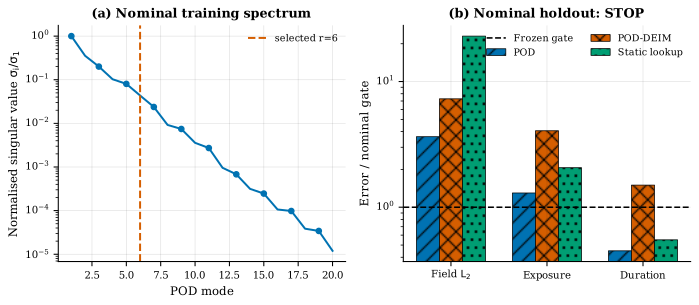
The full-order reference verifies, but both reduced models fail the nominal control. The terminal verdict is STOP_REFERENCE_OR_ROM_INADMISSIBLE. Read When a Reduced Ventilation Model Leaves Its Training Regime for the frozen transport model, training and holdout design, exact nominal failure, non-attributable shift diagnostics, refuted warning and speed gates, two-run reproduction record, visual QA, and the real-building claims that remain outside scope.
Key findings
- Nominal POD and POD-DEIM field errors are 0.181929901217 and 0.364300559015 against the frozen 0.05 gate, so the phase stops before shift attribution.
- The 24-point residual warning has Spearman correlation -0.50 against error, below the declared +0.60 gate, and fails the worst-case ranking test.
- Median accepted-attempt POD-DEIM online speedup is 2.978205301x against a 5x gate; timing excludes offline construction and is environment-specific.
Limitations
- Because nominal admissibility fails, shifted trajectories are diagnostic only and cannot establish that distribution shift caused additional reliability loss.
- The five-case sampled-residual result refutes one frozen warning rule, not all residual diagnostics or all POD/DEIM models.
- The benchmark is a deterministic synthetic passive-scalar surrogate, not a calibrated building, health, infection-risk, controller-safety, or deployment study.
Technical record
Detailed source, calculations, generated figures, and reproduction instructions are maintained in a private technical workspace. Public articles contain only manually reviewed interpretation and approved figures.
Version history
2026-08-30 — Curated overview reviewed against repository evidence.