Overview
This study treats pressure-sensor placement as a fault-tolerant design problem. Instead of asking only whether leak signatures are distinguishable when all sensors work, it scores each layout after every possible one-sensor removal.
Why the problem matters
A leak-localisation pipeline can depend on a small number of pressure sensors. A layout chosen for the intact system may become ambiguous during communications loss, maintenance, power interruption, or sensor rejection. Redundancy therefore needs to be represented in placement, not added only after a failure occurs.
Model, data, and assumptions
The pilot uses a 36-node synthetic meshed network with one fixed-head reservoir and 35 candidate leak zones. A damped graph Laplacian supplies hydraulic-inspired pressure signatures. Seven sensors are chosen by random placement, node degree, nominal greedy separation, or the proposed dropout-aware greedy objective.
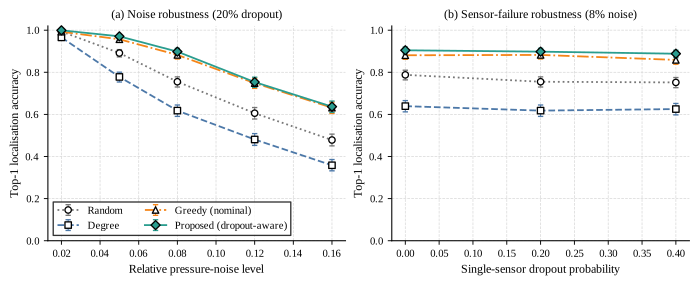
Leak magnitude varies from 0.65 to 1.35. The benchmark adds five relative noise levels and three probabilities of losing one sensor. Localisation fits a non-negative magnitude to every candidate signature and ranks the residuals.
Validation and findings
Every method-condition pair contains 1,225 trials. Common random seeds make the strategy comparison paired at each condition. The designated stress test shows a modest aggregate top-1 improvement and a larger worst-zone improvement over the nominal ablation. At 12% noise and 40% dropout, however, the two greedy methods are effectively level; extreme-noise fairness remains unresolved.
Reproduction
The technical repository contains the source, tests, complete metric table, approved vector figures, long-form technical write-up, and a project-local reproduction guide. A natural follow-up would be to replace the graph proxy with EPANET benchmark hydraulics and add demand and topology uncertainty.
Key findings
- Under the designated 8% noise and 40% single-sensor-dropout stress test, the proposed layout reached 88.8% top-1 accuracy versus 85.9% for its nominal ablation.
- Worst-zone accuracy in that stress test was 65.7% for the proposed layout and 51.4% for the nominal ablation.
- The advantage was not uniform across all noise levels, so the current evidence supports benchmark extension rather than a field-performance claim.
Limitations
- The graph-Laplacian response is a controlled proxy rather than an EPANET or field-calibrated hydraulic model.
- Only one unavailable sensor, independent Gaussian noise, and one leak at a time are represented.
- Aggregate Wilson intervals do not replace a paired significance analysis or account for every within-zone dependence.
Technical record
Detailed source, calculations, generated figures, and reproduction instructions are maintained in a private technical workspace. Public articles contain only manually reviewed interpretation and approved figures.
Version history
2026-07-13 — Curated overview reviewed against repository evidence.