
Overview
This study treats ventilation as a shared allocation problem. Three classrooms draw from one limited command budget. Their published timetable is useful but imperfect: attendance varies, one group can change rooms without notice, and available fan capacity can fall during the school day.
Four controllers receive the same synthetic trajectories. A fixed schedule and a reactive CO₂ rule provide simple baselines. Schedule MPC looks 30 minutes ahead using the timetable. Buffered MPC adds five students to each forecast active room before choosing a feasible command.
Model, data, and assumptions
Each 180 m³ room follows a well-mixed CO₂ mass balance at five-minute resolution. Actual occupancy is generated from nine scheduled class blocks with attendance variation. Stress conditions introduce an unannounced transfer of 10–16 people and a three-hour shared-capacity derating.
The benchmark uses 1000 ppm as a control target so strategies can be compared consistently. It is not presented as a direct health or safety boundary. The model omits airflow geometry, door opening, filtration, aerosols, equipment commissioning, and local ventilation-code requirements.
Validation and findings
Each controller-condition pair contains 120 replicates. Physical seeds are matched across controllers, so paired differences isolate the control rule rather than a different random day. Means use bootstrap 95% intervals, and buffered-versus-schedule MPC uses a paired bootstrap.
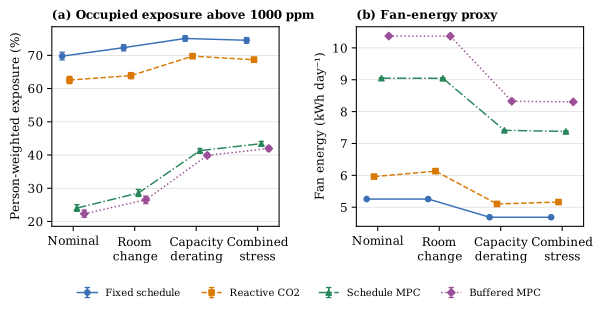
The predictive methods use more fan command and reduce occupied exposure in this generator. The extra occupancy buffer produces a further but small reduction, while increasing fan energy and slightly worsening the unweighted whole-day peak. The result is a trade-off, not a universal controller ranking.
Reproduction and next evidence
The technical repository contains configuration, source, unit tests, every trial result, aggregate and paired tables, a claim-evidence map, source ledger, approved SVG figures, and a long-form technical study. A credible next step would calibrate the mass balance and fan law against instrumented classrooms, then replay independently recorded timetable deviations without retuning the controller on the test building.
Key findings
- Under an unannounced room change plus shared-capacity derating, mean person-weighted exposure above the 1000 ppm study line was 74.5% for fixed schedule, 68.7% for reactive CO₂, 43.4% for schedule MPC, and 42.0% for buffered MPC.
- Relative to schedule MPC, the five-student buffer changed exposure by -1.45 percentage points while increasing the fan-energy proxy by 0.93 kWh/day.
- Buffered MPC slightly increased the unweighted whole-day peak, showing that lower occupied exposure does not guarantee a lower worst-room maximum.
Limitations
- The rooms are well-mixed synthetic zones rather than calibrated classrooms or a commissioned air-handling system.
- The 1000 ppm line is a benchmark control target and not a universal health, safety, or compliance threshold.
- Fan energy and ventilation thermal load are proxies; aerosols, filtration, infection risk, and health outcomes are not modelled.
Technical record
Detailed source, calculations, generated figures, and reproduction instructions are maintained in a private technical workspace. Public articles contain only manually reviewed interpretation and approved figures.
Version history
2026-07-15 — Curated overview reviewed against repository evidence.