Overview
The model couples host and vector dynamics to diffusion, long-range movement, and temperature-dependent mosquito ecology. Its value is as a controlled computational laboratory: assumptions can be changed and numerical behavior checked without presenting the result as a city forecast.
Validation
The project includes a numerical verification entry point and automated tests. Those checks address implementation and numerical consistency; they do not substitute for epidemiological calibration or external predictive validation.
Reproduction
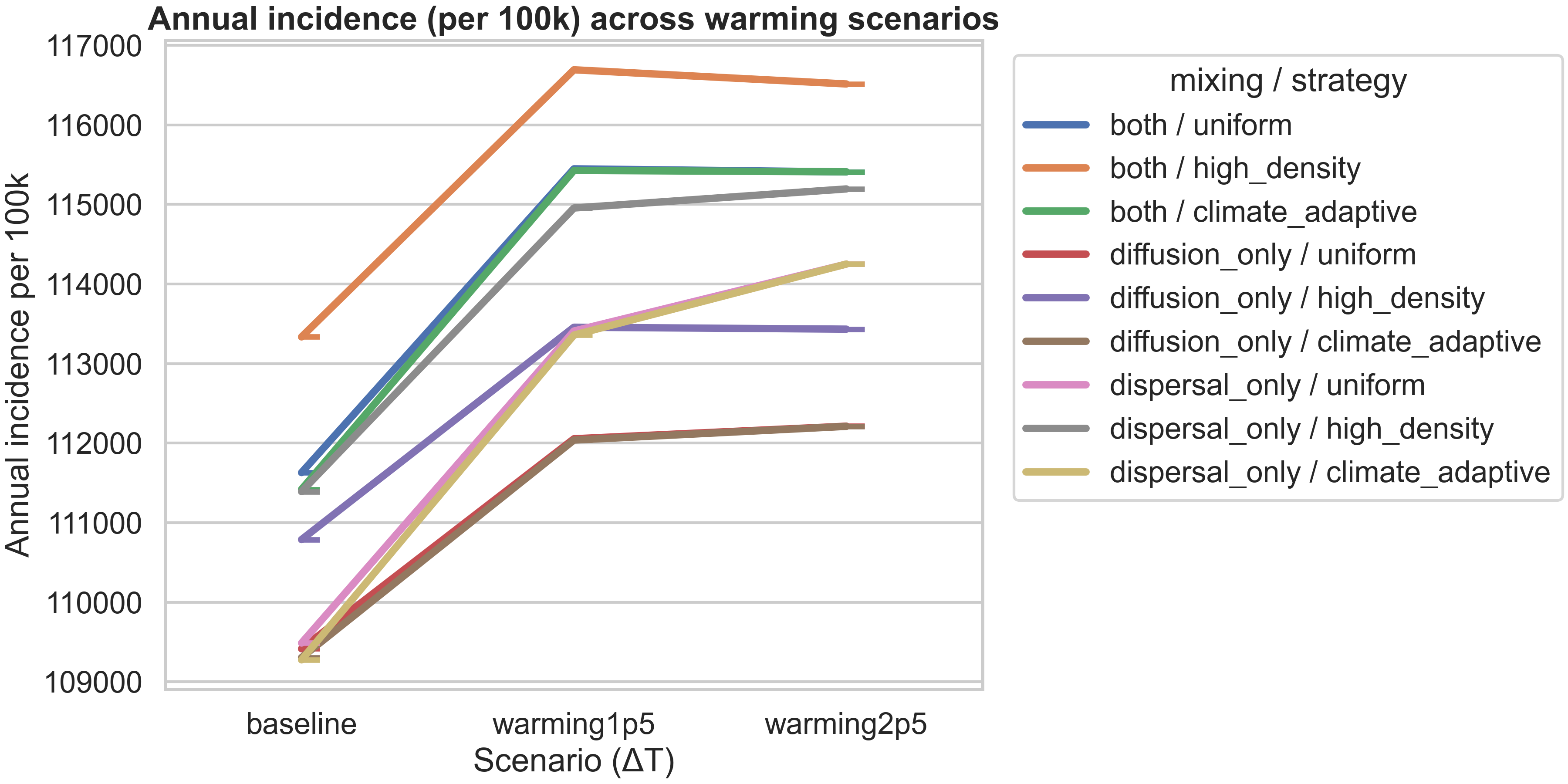
The documented experiment matrix is generated with python run_experiment_matrix.py --tfinal 365 --grid 30 --dt 0.2 --save 30 --forcing default inside the project environment.
Key findings
- Spatial forcing can produce heterogeneous simulated incidence fields.
- Allocation strategies can be compared under shared synthetic assumptions.
Limitations
- The published experiment matrix is synthetic.
- Outputs are scenario comparisons, not forecasts for a specific city.
- Biological parameters require empirical calibration before applied use.
Technical record
Detailed source, calculations, generated figures, and reproduction instructions are maintained in a private technical workspace. Public articles contain only manually reviewed interpretation and approved figures.
Version history
2026-01-30 — Curated overview reviewed against repository evidence.