Overview
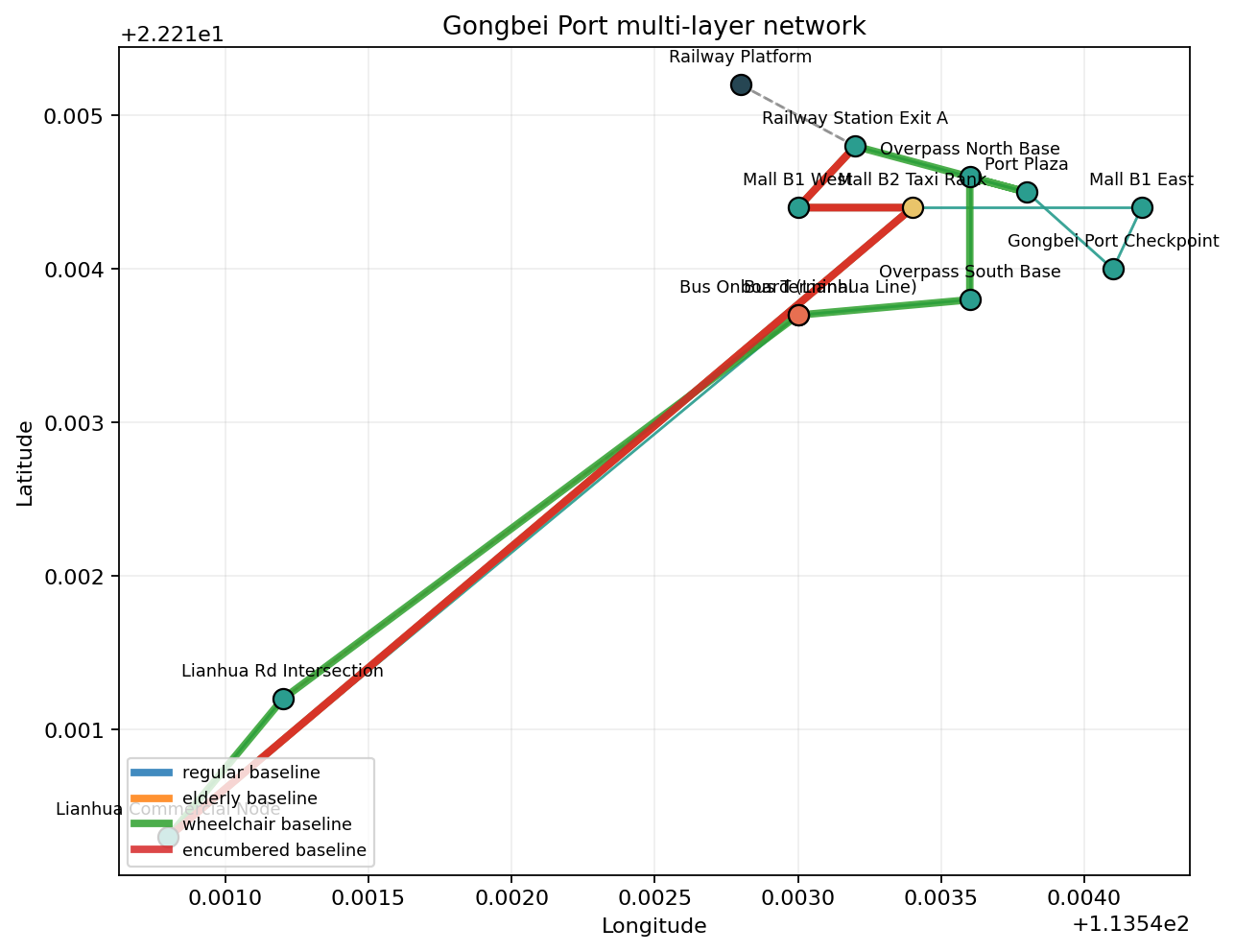
This study represents pedestrian, bus, rail, and taxi layers as a coupled network. It replaces a single “average traveler” with configured regular, elderly, encumbered, and wheelchair cohorts.
Why the problem matters
The geographically shortest path can be unusable when it contains a stair or an inaccessible transfer. A routing objective that ignores these barriers can hide the travel cost imposed on people with limited mobility.
Model, data, and assumptions
The pipeline combines a Walking Difficulty Index, generalized travel cost, demographic-aware Dijkstra routing, Pareto label setting, and weighted betweenness. The Gongbei network is a case-study representation; behavioral costs are modeled assumptions rather than direct observations of every traveler.
Validation and findings
Sensitivity analysis decomposes variation in modeled travel cost, while cascading edge removal tests route redundancy. The reported intervention comparison suggests that elevator and low-floor-transfer changes reduce modeled wheelchair travel cost, but this has not been evaluated as a deployed intervention.
Reproduction
The technical repository provides bilingual reports, figures, configuration, and the command python SJMMA2026/ProblemA/run.py --mode all.
Key findings
- Mode and route choices change when vertical barriers are represented explicitly.
- The model identifies slope and transfer assumptions as important drivers for the wheelchair cohort.
Limitations
- The case study covers one 1 km² hub.
- Several behavioral and accessibility costs require local calibration.
- Policy implications are model-based rather than evidence from a deployed intervention.
Technical record
Detailed source, calculations, generated figures, and reproduction instructions are maintained in a private technical workspace. Public articles contain only manually reviewed interpretation and approved figures.
Version history
2026-04-30 — Curated overview reviewed against repository evidence.